
The Sound of Resistance
Part I: When Politics Failed, Hip Hop Spoke
Hip hop has always been more than music. From its origins in the South Bronx to modern artists like Kendrick Lamar and Childish Gambino, hip hop has functioned as a socio-political movement and a voice for marginalized communities. This article explores the political roots of hip hop, its role as cultural resistance, and how boom bap became a sound shaped by history, power, and survival.
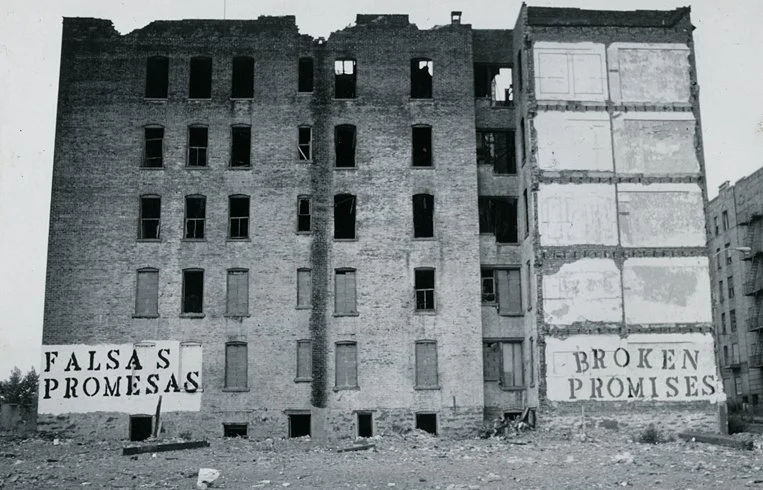
South Bronx, NY 1980
Photograph by John Fekner
Hip hop has often been described as music, a genre, or an industry. These descriptions are convenient, but they are incomplete. Hip hop emerged not from artistic luxury, but from political absence. It was born in places where systems collapsed, representation was denied, and official channels offered silence instead of solutions. In those conditions, expression became survival.
From the burned-out blocks of the South Bronx in the 1970s, hip hop rose as a cultural response to structural neglect. Redlining, aggressive urban renewal projects, economic abandonment, and heavy policing reshaped entire neighborhoods while excluding the people who lived in them from decision-making. Communities were not simply underfunded. They were ignored. Hip hop did not attempt to escape this reality. It documented it. It named it. It challenged it. Culture stepped in when politics failed to listen.
In its earliest form, hip hop functioned as a living archive of daily life. DJs extended breakbeats because instruments were inaccessible. MCs narrated their surroundings because no one else would. Graffiti reclaimed public space that had been written off. Breakdancing transformed physical struggle into discipline and style. These were not isolated practices. Together, they formed a language of presence in environments designed to produce invisibility.
As the culture matured, it’s urgency sharpened. By the late 1980s, hip hop no longer only described conditions. It interrogated power. Groups like Public Enemy transformed rap into political confrontation, refusing neutrality and embracing accountability. Songs such as Fight the Power were not metaphorical protests. They were direct challenges to institutional racism, media control, and cultural mythology. Hip hop became reportage, analysis, and resistance, operating outside official platforms while reaching mass audiences.
This political current extended far beyond the most visible names. Underground artists and collectives used hip hop to explore Afrocentric history, police violence, religious critique, and systemic inequality. The boom bap sound became the ideal vessel for this expression, shaped not only by intention, but by the machines that made raw, confrontational hip hop possible. Its hard drums and stripped arrangements refused distraction. The kick and snare carried authority, leaving space for language to strike with precision. Boom bap did not decorate the message. It enforced it.
The response from institutions was telling. Hip hop was monitored, censored, and criminalized. Albums were labeled as dangerous. Lyrics were quoted in courtrooms. Entire communities were framed as threats through the art they produced. Hip hop was not targeted because it exaggerated reality. It was targeted because it described it too clearly.
Despite this pressure, the political function of hip hop did not disappear as the culture entered the mainstream. It adapted. In different eras, resistance took different forms. Sometimes it shouted. Sometimes it reflected. Artists like Kendrick Lamar examined systemic racism, internalized trauma, and survival within systems that profit from Black culture while exploiting Black bodies. His work demonstrated that political hip hop could exist inside the mainstream without surrendering its depth. Songs like Alright moved beyond music, becoming protest chants in the streets and reaffirming hip hop’s role as a voice of resistance when political systems failed to protect Black lives.
That lineage reached a defining modern moment with Childish Gambino and This Is America. Released as both song and spectacle, it exposed how violence, entertainment, and distraction coexist in contemporary America. While melodies entertained, chaos unfolded in the background. The piece forced listeners and viewers to confront how easily outrage is replaced by consumption, and how Black expression is embraced even as Black lives remain disposable.
What connects these generations is not sound alone, but intention. Hip hop consistently emerges where voices are marginalized and narratives are controlled by others. It adapts to new conditions while preserving its original function as cultural resistance. Boom bap today exists not as nostalgia, but as preservation. It carries the architecture of a time when drums were built to confront and lyrics were built to matter.
Understanding hip hop as a socio-political movement reshapes how we listen. Beats become context. Lyrics become documentation. Songs become historical records tied to specific policies, neighborhoods, and lived experiences. Hip hop is not adjacent to politics. It is politics translated into rhythm, language, and truth.
Hip hop did not ask to be included.
It created its own space when none existed.
The sound was never neutral.
It was resistance.